

Most of us know exactly which mascara we love, and many of us hold on to it longer than we should. A tube that still seems to have product left can feel wasteful to toss, particularly when it applies the way you like. It is also easy to find an older tube in a drawer or travel bag and assume it is still fine to use.
The short answer is that you should replace your mascara every three months after opening it, whether it is a clean formula or a conventional one. If you notice a change in smell, texture, or how it feels on your eyes before then, replace it sooner. This guideline is widely recommended by eye health experts and by the U.S. Food and Drug Administration because mascara is used directly at the lash line and can collect bacteria over time.
As a Board-Certified Nurse Practitioner, I have seen what can happen when this guideline is ignored. I have treated patients with conjunctivitis and styes who admitted to using an old mascara they had found and decided to try again. As the product developer behind Crunchi, I also think carefully about what keeps a formula safe from the day it is opened to the day it should be discarded. Mascara deserves especially close care, and I would like to explain why.
Does Mascara Expire?
Yes, how long mascara lasts can vary depending on how frequently it’s used, the number of coats applied, and how it’s handled. For example, pumping the wand can introduce air into the tube, causing the formula to dry out faster and affecting its consistency. More importantly, for hygiene reasons, we strongly recommend replacing mascara every three months after opening, regardless of how much product remains. An unopened tubes shelf life is based on its manufacturing date.
The moment you open a new tube, air and microorganisms begin to enter it. Every time the wand touches your lashes and returns to the tube, it can carry bacteria from your skin and eyelids back into the formula. The tube is dark, moist, and closed, which is an environment where microorganisms can grow. Preservatives help slow that process, although no preservative system is designed to protect a product indefinitely.
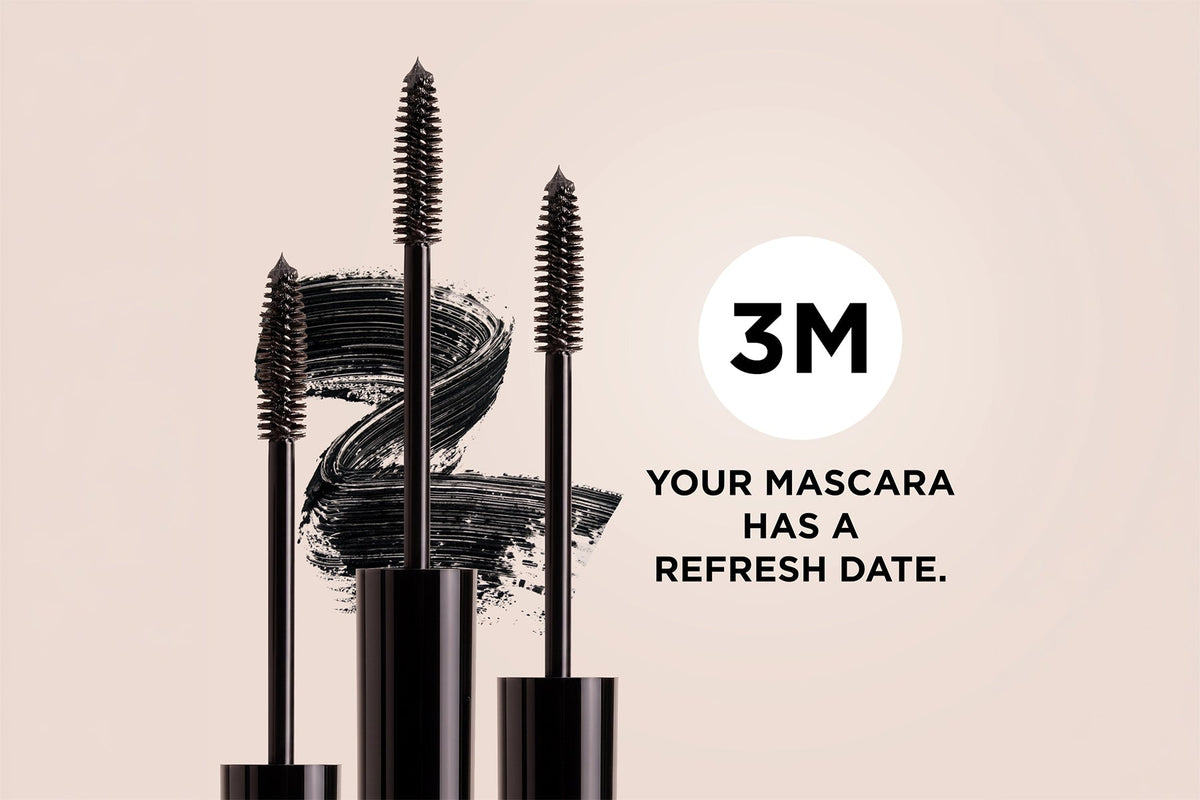
Many cosmetics carry a period-after-opening symbol, which looks like a small open jar with a number and the letter "M" for months. On mascara, this is often "3M," meaning the product should be discarded three months after opening.
Why Is Mascara Replaced Every Three Months?
The three-month guideline is based on how quickly used mascara can become contaminated. In a study published in Optometry, researchers found microbial growth in more than 35% of mascara tubes after three months of regular use by a single person. The most common organisms were Staphylococcus epidermidis, Streptococcus species, and fungi (Pack et al., 2008).
Those organisms are commonly found on skin, and in small amounts they usually cause no trouble. One important thing to keep in mind is that the eye is far more vulnerable than the skin on your arm. A tiny scratch from a wand, an already irritated eye, or simply a larger amount of bacteria can allow an infection to take hold.
The FDA and experts at the University of Rochester Medical Center both recommend replacing eye makeup every few months for this reason.
Why Eye Products Deserve Extra Care
Mascara is applied closer to your eyes than almost any other product in your routine, and your eyes are not something to take chances with. Most eye irritation from makeup is mild and resolves with care. Even so, a serious infection of the cornea, the clear front surface of the eye, can lead to scarring and permanent vision loss.
The CDC has documented a case in which a woman scratched her eye with a mascara applicator and developed a severe corneal infection. The same bacteria, Pseudomonas aeruginosa, was found in both her eye and her mascara, and her vision was significantly impaired (CDC, MMWR). Cases this severe are rare. They are also a clear reminder of why a fresh tube is worth the small cost.
How to Tell Your Mascara Has Gone Bad
Even before three months, these signs suggest your mascara should be replaced:
- A change in smell. A sour, musty, or unusual odor can signal bacterial growth.
- A change in texture. Mascara that has become dry, clumpy, stringy, or noticeably watery is past its best.
- Irritation when you wear it. Redness, itching, burning, or watery eyes after application are reasons to stop using it right away.
Pumping the wand in and out of the tube, adding water, or thinning old mascara with another product does not restore it. These habits push more air and bacteria into the tube and can make contamination more likely.
How to Read the Three-Month Symbol and Batch Code
On Shattered® Peptide Mascara, you will find the 3M period-after-opening symbol on the unit carton. Its purpose is simple: it reminds you to discard the mascara three months after you open it. This guideline is not unique to clean mascaras. It applies to conventional mascaras as well.
If you wear mascara every day, you will likely finish a tube in one to two months, well before the three-month mark. For occasional wearers, a helpful habit is to write the date you opened the tube on the carton or set a reminder on your phone.
The shelf life of an unopened Crunchi® mascara depends on its date of manufacture, which is reflected in the batch code printed on the tube. Most people begin using a mascara soon after purchasing it. If you have purchased several tubes and would like to know the exact shelf life of your batch, our team is happy to help. Simply contact us with your batch code.
What to Do If You Have an Eye Infection
If your healthcare provider has diagnosed you with conjunctivitis, often called pink eye, or a stye, your eye makeup can hold the same bacteria that caused the infection. Using those products again can lead to reinfection. In addition to the treatment prescribed by your healthcare provider, the following steps are also recommended:
- Stop wearing all eye makeup until the infection has fully cleared.
- Discard every product that touched your eyes during the infection, including mascara, eyeliner, and any other eye products such as cream shadows.
- Wash or replace your brushes and applicators, including eyeshadow and brow brushes.
- Start fresh with new products once your eyes have healed.
Simple Habits That Keep Mascara Safer
A few everyday habits can help your mascara stay cleaner for its full life:
- Never share mascara, even with family or close friends.
- Avoid testers applied directly to the eye in stores.
- Close the tube tightly after every use.
- Store it at room temperature, away from a hot car or steamy bathroom.
- Remove mascara gently every night to reduce buildup and friction on your lashes. Our guide on how to remove mascara without damaging your lashes walks through each step.
- Avoid applying mascara in a moving car, where a small bump can lead to a scratch.
The Crunchi Difference
At Crunchi, safety is not limited to the ingredient list. We also consider how a formula holds up while you use it. Because mascara is used at one of the most sensitive areas of your face, Shattered® Peptide Mascara is ophthalmologically tested and suitable for sensitive eyes and contact lens wearers. Its formula also underwent double preservative efficacy testing, known as double PET. Preservative efficacy testing, sometimes called a challenge test, introduces bacteria, mold, and yeast into a product and measures how well its preservative system reduces them over several weeks. Double PET repeats that challenge, which shows whether the formula can keep protecting itself after repeated exposure, much like a mascara wand returning to the tube day after day. The industry standard is a single test, so double PET goes beyond what is typically required for products used around the eyes.
We also choose not to use concerning ingredients that are common in mascaras, including ethoxylated ingredients, PTFE, BHT, carbon black, and many others. Shattered® Peptide Mascara is EWG Verified®, and it is third-party tested for heavy metals. Even with this level of care, the three-month guideline still applies. A well-preserved formula is designed to stay safe for its intended life, and that life begins the day you open it.
Shattered® Peptide Mascara combines buildable volume and definition with lash-conditioning care from a targeted peptide, Pro-Vitamin B5, and glycerin. Since a fresh tube every few months is part of healthy eye hygiene, it should be one you look forward to.
Discover Shattered® Peptide Mascara
Frequently Asked Questions
How often should you replace your mascara?
Every three months after opening. Replace it sooner if it changes in smell or texture, or if it irritates your eyes.
Does unopened mascara expire?
Yes. Its shelf life depends on its date of manufacture. For Crunchi® mascara, you can contact us with the batch code printed on your tube to learn the exact shelf life of that batch.
Can old mascara cause an eye infection?
Yes, it can. Used mascara can collect bacteria over time, and old mascara has been associated with conjunctivitis, styes, and, in rare cases, more serious infections of the eye.
Does clean mascara need to be replaced as often as conventional mascara?
Yes. The three-month guideline applies to every mascara, whether it is clean or conventional, because contamination comes from use rather than from the type of formula.
Should I throw away my mascara after pink eye?
Yes. Discard mascara, eyeliner, and any other products that touched your eyes during the infection, and wash or replace your brushes.
Can I add water to dried-out mascara?
No. Adding water or other liquids can introduce bacteria and weaken the preservative system. Dried-out mascara is a sign that it is time for a new tube.
Sources
- Pack LD, Wickham MG, Enloe RA, Hill DN. Microbial contamination associated with mascara use. Optometry. 2008.
- Centers for Disease Control and Prevention. Pseudomonas aeruginosa corneal infection related to mascara applicator trauma, Georgia. MMWR.
- U.S. Food and Drug Administration. Shelf Life and Expiration Dating of Cosmetics.
- University of Rochester Medical Center. Old Makeup Can Cause Serious Eye Infections.
About the Author
Melanie Petschke is a Board-Certified Nurse Practitioner and co-founder of Crunchi®, an EWG Verified® clean beauty brand. She has over 15 years of experience studying ingredient safety and over a decade in product development. She writes about ingredient safety, clean living, and the science behind what we put on our skin.


Leave a comment
This site is protected by hCaptcha and the hCaptcha Privacy Policy and Terms of Service apply.